Showing posts with label Guest Post. Show all posts

Wednesday, 23 March 2016

Eight Benefits of Living in a Community Housing

Buying a house is a massive investment any person can make. When purchasing your dream home, you should consider many factors. These can include price, location, size, floor plan, and house type, among others. Gambling with your future is not something you want to try. You have to go for the best housing project available. To save yourself from these conundrums you can opt for community housing. It's unique, unlike the traditional neighborhoods. A Community has areas designed to suit the needs of the residents. The benefits of finding a home in a community include:

You Stand out from the Rest

In the past, architects constructed most homes with the neighborhood concept. But, this has changed in modern times. Current developments are set up with the surrounding area in mind. It means that social amenities such as schools, parks, hospitals, banking, and other facilities are developed around them. Also, restaurants, grocery stores, schools, and entertainment facilities are developed along the community housing. In most cases, any community planning focuses on important details to include all the primary necessities. Most communities are centered on a particular theme such as lakes, tennis facilities, golf, or any other interactive feature. What makes the neighborhood unique is the fact that developers consider everything first before setting it up.

Exceptional Landscaping

Who doesn’t want to live in a community with beautifully trimmed lawns and easily accessible areas? You can reap many benefits by using sites like Property Guru to search for community housing ventures like Desa park city — meticulous landscaping is one of these features. What more the communities provide you with an area to jog, biking, and playgrounds. The pricing is competitive because the communities are all similar in their floor plan.

Don’t Worry About Devaluation 

An exceptional feature of the community housing is that the pricing remains steady. The owners of these houses keep the property in good condition throughout. Your dreams will come true when you settle in the park. The owners use top-notch contractors with years of experience to develop the property so you will get the best talent working on it in the market. Quality construction is beneficial because you don’t have to worry about repairs, you can just maintain the house in its current condition.

Space Brings Creativity 

As expert developers build homes, you will have more space inside and outside. Unlike the traditional neighborhood areas, a community housing will give you ample space for use. You can convert the outside space to be a patio or anything that suits your needs. You will enjoy a wide array of advantages from these homes. The materials used in the construction of the house are top quality, and residents benefit from the convenience of having all the facilities within the area. If you are into arts or any outdoor activity, then community housing is the best option for you.

It's a Proven Model

When investing for your future, you wouldn’t want to gamble your hard-earned cash. Invest in a proven model. AV homes website indicates there is significant growth in community housing. The model has received accolades for being one of the most practical designs. You can live comfortably knowing that the neighborhood is safe. Many have realized the benefits of community housing, and they are buying or renting such properties in large numbers.

You Get Full Value for Your Money

Investing in a home is not something you rush into and make a purchase. When you are looking for a solid housing investment, community housing is the best option. You get full value for your money as you can leverage on different forms of funding. Also, you can use it to borrow against property this allows you to improve your financial position with ease.

Flexibility Factor

Flexibility is the main factor people consider when looking for housing, and community housing will give you the ultimate experience. The housing cost is low, and you can enjoy the freedom of funding through shared equity. This kind of flexibility has made the community model better placed and specialized to address complex housing needs. You can easily fund the housing as Richmond American suggests.

Independent and Responsive 

Community housing is created with the needs of the occupant at hand. Not only will you get a quality house but also a dynamic environment that will suit your needs. The developers put the needs of the occupant in mind when developing the housing and suit your independent lifestyle. You can take a long-term approach to investing in your dream home and customize it to suit your preferences according to Connerton builders.

In conclusion, community housing provides total flexibility, comfort, and adequate space where you can bring your ideas to life. Do not invest in non-proven models, always go for time-tested models when so much money is involved, and it will bring satisfaction to all your housing needs.

Thursday, 21 January 2016

No Medisave Minimum Sum From 1 January 2016 – Here Is What You Need To Know About It

This article was first published by DollarsAndSense.sg

During the Singapore Budget earlier this year, an announcement was made pertaining to the Medisave Account. Starting from 1 January 2016, there will no longer be any Medisave Minimum Sum (MMS) in place for CPF members.

With 2016 approaching, we decide to revisit this change and look at how it would impact Singaporeans, especially those who are approaching the age of 55.


Scrapping Of The Medisave Minimum Sum

Under the previous scheme, CPF members would need to ensure that they have hit the MMS ($43,500 in 2015) before being able to withdraw excess funds (funds above what is set aside for the Retirement Account) from their CPF Special and Ordinary Account. If they have not hit the MMS level, they will need to provide a top-up from the other CPF accounts to their Medisave first.

From 2016 onwards, there would no longer be any MMS. Essentially, what this means is that CPF members can choose to withdraw monies from their Ordinary and Special Accounts at the age of 55 after having set aside for their Retirement Account (RA).

An Illustration

For illustration purposes, let’s assume 54-year old has the following assets in his CPF Accounts

CPF AccountBefore 55After 55 (Old Scheme)After 55 (New Scheme)
Ordinary Account & Special Account$120,000 $26,000 $39,500
Retirement Account$0 * $80,500* $80,500
Medisave$30,000 $43,500 (top-up of $13,500)$30,000 (no top-up)
Total$150,000 $150,000 $150,000
* Opt for Basic Retirement Sum of $80,500 and pledge of property

In our example, the individual is able to withdraw an extra $13,500 because he no longer needs to top-up his Medisave Account.


Medisave Contribution Ceiling Becomes Basic Healthcare Retirement Sum

 For those of you who do not know, there is currently a Medisave Contribution Ceiling (MCC), which is $48,500 as at 2015. That means that even if you want to, your Medisave Account cannot go beyond $48,500.

Any further contributions made to Medisave after your MCC has been reached will automatically be diverted to your Special Account instead.

In true Singapore spirit, we will be renaming the MCC from one acronym to another. So we will be going from the MCC to the BHS, which stands for the Basic Healthcare Retirement. Don’t get confused; they are essentially the same thing.

One thing to note about the MCC BHS is that in order to stay relevant with the inevitable rise in healthcare cost in the future, the BHS will be reviewed and adjusted annually.


What Does All These Means To Us?

Whenever we contribute monthly to our CPF accounts, it goes into three different accounts, Ordinary, Special and Medisave. All of these accounts serve different purposes, with Medisave being used for health-related expenses incurred by the individual.

The scrapping of the Medisave Minimum Sum means that regardless of how little you have in your Medisave account, it would have no impact on the money you can withdraw from your Ordinary and Special Accounts after 55. It would require no extra top-ups; aside from the contributions it receives as part of the CPF monthly contributions when the individual is working.

Planning for our healthcare needs is an important aspect of personal finance planning. In this aspect, your Medisave Account is an independent, stand-alone account created to help cover your hospitalisation and healthcare needs.

DollarsAndSense.sg is a website that aims to provide interesting, bite-sized financial articles which are relevant to the average Singaporean. Subscribe to our free e-newsletter to receive exclusive content not available on our website. Follow us as well on Instagram @DNSsingapore to get your daily dose of finance knowledge through photos. 

Monday, 16 November 2015

Term Insurance Or Whole Life Insurance? Which Is A Better Choice?

My Encounters with Insurance

For the longest period of time, whole life insurance and insurance savings plan (endowment plans) were the only thing I know which existed in the market. 9 years ago when I was at the age of 18, I had my first encounter with insurance. I was still a student back then and was approached by a financial consultant on the streets while I was going out. I'm sure many of you have been approached before too. I agreed to hear more about insurance and sat at a MacDonalds with this consultant for the next 1 hour plus listening to what insurance is all about. I was introduced a savings plan and was told the interest will certainly be more than a bank's interest. Besides that, this plan also has death, total permanent disability (TPD) and critical illness coverage. It kinda makes sense that I can put in money, get higher returns for my money and still get the coverage. It sounds so attractive that I signed up on the spot. To this day, I still have the policy which I've been paying for the past 9 years.

The policy which I had, although has a coverage for death, total permanent disability and critical illness, was only $10,000. It is certainly not enough should I have dependants or if I need to provide for my parents in the future. My next few encounters with financial consultants was on the topic of whole life insurance. This time round, I took my time to decide whether to take up an insurance policy as the premiums weren't cheap. Many times, I was recommended policies with $100,000-$200,000 coverage at premiums of $200 per month or $2400 a year. I only just started working back then and didn't have a high starting salary. Paying $2400 a year is still quite a big sum of money to me.

Fast forward to today, I didn't purchase the whole life insurance for only $100,000-$200,000 coverage for $2400 per year. Later on, I found out another insurance called term insurance which I could get One Million coverage for only about $1500 a year. The same $200,000 coverage would only cost $300 a year back then instead of the $2400 which I was recommended. Why is there such a big difference in the premiums?

*Disclaimer: Before I continue, this post is not a recommendation for any insurance policies as I'm not here to do that. I will only list down the facts of what term insurance or life insurance is and let you see for yourself which is a better choice. Let's start!

Term Insurance Or Whole Life Insurance?

During NTUC Income's 40th anniversary dinner, Senior Minister Goh Chok Tong supported the use of term insurances and even asked insurers to put more emphasis on it. Let's see the rationale behind term insurance and whole life insurance and find out which is a better choice?

Whole Life insurance premiums are definitely much more expensive than that of a term insurance for a similar coverage. A person at the age of 20 can get a $200,000 death and TPD coverage for just $300 a year with a term insurance as compared to $2000+ a year for a whole life insurance. For whole life insurance, you get something back when you terminate your policy but for a term insurance, you would get nothing back at all. This is the argument put forth which discourages term insurance.

However, let's understand why we would get something back for a whole life insurance and not for a term insurance? For a whole life insurance, every dollar you pay as premium for the whole life plan, a portion will go into paying the mortality charge that provides you the cover you need. The rest of it is invested into the insurance company’s life fund. The mortality charge portion is never returned back to you. The only reason why you get money back from a whole life plan is because you gave the insurance companies extra money to invest. When you buy a term plan, you are effectively paying only for the mortality charge; you are just buying pure protection.

Have you heard of the phrase buy term and invest the rest? This is saying we should buy term insurance and invest the rest of our money on our own. Instead of putting our money into the insurance company's life fund, we can invest our own money and manage our own fund. This is of course subjected to individual preference. Some may not know how to invest their money and would still be better off putting their money in the insurance life fund.

But, there is a problem with whole life plans. If let's say we want to get 1 Million insurance coverage, it becomes too expensive if we were to get a whole life insurance. A check on DIYInsurance's comparison portal shows that a $100,000 coverage for whole life insurance would cost between $1600-$1900 a year. How much would a One Million coverage cost for life insurance? It could easily be above $10K a year.

DIYInsurance has also launched a term insurance table to compare the premiums across insurance companies in Singapore. The following is a table adapted from DIYInsurance's website for your reference. This Term Insurance table is also updated monthly by them.

We consider the following example of a Male, Non-Smoker:

  • Policy coverage till 65 years old (Eg. when children are independent)
  • S$1million Death and Total Permanent Disability (TPD) Coverage

Annual premiums of insurers in Singapore (S$):

AgeAvivaAXA LifeEtiqaGreat EasternHSBC InsuranceManulifeNTUC IncomePrudentialZurich LifeApply for Cheapest
30108710881990156013391202181016581304Apply 
40183518713440269026402016268125672001Apply 
50337933795330426044943701470242683549Apply 

For a Female, Non-Smoker,

Annual premiums of insurers in Singapore (S$):

AgeAvivaAXA LifeEtiqaGreat EasternHSBC InsuranceManulifeNTUC IncomePrudentialZurich LifeApply for Cheapest
3086879113901070100894813501249967Apply 
40139013572370175019801410210718811506Apply 
50245020783450260031442276385030492661Apply 
*With information from www.diyinsurance.com.sg and comparefirst. Figures are compiled on 5th November 2015.

** Prices reflected in the table reflect ongoing existing promotions and discounts which are in the knowledge of.

Term insurance or whole life insurance? You can make your decision base on the information provided above. There are many ways to compare insurance premiums now in this IT savvy world we live in. All of us can make better informed choices!

DIYInsurance by Providend Ltd

To compare and purchase insurance, DIYInsurance (Do It Your Way Insurance) is Singapore's First Life Insurance Comparison Web Portal by Providend Ltd. DIYInsurance aggregates products from various insurance companies and provides 30% commission rebates in addition to ongoing promotions.

Backed by key people with almost 2 decades of experience, all staff from DIYInsurance are salaried based and do not participate in sales-based compensation or incentives of any kind. Not being remunerated on a commission-basis means there is no hard-selling and over-selling. This is insurance based on no one's agenda except your own. Click here to request a Term Life Insurance quote through DIYInsurance.

*This post is written in collaboration with DIYInsurance. The opinions and expressions in this article are solely based on my own thoughts and experiences. 

Thursday, 5 November 2015

Benefits of Crowd Lending VS Stock Trading

Crowd lending or crowd funding is something very new in Singapore. In the past few months, there are more and more reports on the mainstream media on crowd lending in Singapore which resulted in more people investing their money through these crowd lending platforms. I have written on crowd lending and also on stock trading before. I mentioned before that many young people started out trading in the stock market partly because of the lure of quick money. Both crowd lending and stock trading has its risks and I'll explore the differences between these two. Let's see which is a better choice for most people to start with.


Is it that easy to make money through stock trading? 

Trading is a psychology game. Buying and selling stocks in the short term while betting on price movement requires a lot of hard work too. We've heard traders who earn tens of thousands in a very short time and we see these advertisements very frequently on those trading workshops. Some of these workshops even have software to help you trade and make money automatically. It was said this eliminates the psychology aspect and doesn't require much effort on our part. Is it really that easy to make money?

I heard a real life story of a lady who was retrenched during the 2007/08 financial crisis. She was a futures broker in a financial institution for 17 years. She worked mostly from 6pm in the evening to 5am in the morning trading futures market.

After being retrenched, she thought she would be able to trade at home and have time to look after her son. But, within 10 months into trading at home, she lost quite a lot of money and stopped. Why did she lose money? She said trading in a financial institution allowed her to have tips and instant news to make decisions fast. Trading at home is different as most of the time the news is delayed. The second reason is trading an institution money's is different from trading your own money. The emotional and psychological aspect is completely different. Even with the experience and knowledge of trading, it is still highly possible to lose money.

After hearing this story, it made me realise trading is not easy. Firstly, I've heard that most people lose money in trading and it is said that only 5% of the traders in the world can make money consistently. Secondly, I've heard that trading is a psychological and emotional game. If you can't control your emotions, you can't be successful in trading. This point is also confirmed.

So is it still possible to make money through trading? I think it is still possible to make money from trading but it will not be a lot of money. In actual fact, very few people are full time traders. Most trade on the sideline occasionally. You may not agree with me but I've traded before and know what it is like to lose money. It is really an emotional game. Want to make a lot of money through trading? Think again.


What about investing through Crowd lending platforms? 

Investing through crowd lending platforms can yield you more than 10% a year. That is a pretty decent return on investment. Wait... some of you may be thinking this sound too good to be true? How can there be such thing as a more than 10% yield on investment? Let's pause for awhile and take a look at how crowd lending works to understand it better.

Crowd-funding is the practice of funding a project or venture by raising monetary contributions from a large number of people, typically via the internet. One of the crowd-funding platform for businesses in Singapore is Moolahsense. MoolahSense, as quoted on their website, is “a trusted P2B lending platform that empowers investors to stimulate economic growth by providing finance directly to growth SMEs, in exchange for an attractive rate of interest.”

MoolahSense co-founded by the CEO Mr Lawrence Yong, who has been a practitioner in the financial sector for the past 12 years, with experiences spanning private wealth management and investment banking. MoolahSense has opened up a whole new avenue for us ordinary investors who want a part to play in investing in SMEs in Singapore.

The investment opportunity provided by MoolahSense is essentially a bond-like program where one can lend money to the SMEs and get interest in return on a certain time period – either on a monthly or one-time basis. Only 1 in 20 SMEs get funding from banks even though they contribute greatly in the economy of Singapore. Crowdfunding is a win-win situation for both SMEs and investors. SMEs get the funding they want and investors get the interest in return.

In simple layman terms, when we crowd fund a company, we are lending money to that company in exchange of some interest. We become lenders just like when the bank lends money to individuals, they charge an interest in exchange for the loan.


Crowd Lending VS Stock Trading

Limited Losses

Every investment has its own risks. Stock trading can make you a lot of money but can also make you lose a lot of money. I've heard of people who lost hundreds of thousands of dollars through stock trading. Stock trading like Forex, options or futures is highly risky as we can lose more than the amount we have.

For crowd lending, your losses are limited to the amount you invest in. For example if you invest $1000 and the company defaults on its payment, you will only lose a maximum of $1000. Moolahsense, a crowd lending platform, limits the risks for investors by meeting up with the management of the company, engaging them in investors sessions and in the case of default, they have directors of the individual companies as guarantors and also debt collectors agencies to recover the money.

Timing the market and volatility

As mentioned earlier, trading is a psychology game. Why so few traders are profitable in the long run is because the market is always changing. The market is volatile and is definitely not for the weak hearted. Nevertheless, there are still some successful traders who manage to make money from trading the markets.

For crowd lending, we are essentially just lending to a corporation. The returns are in the form of interest payable to us as we lend to these corporations. In crowd lending particularly, we are lending to SMEs. The returns are predictable so there is no need to time the market or be subjected to the volatility like the stock market.

Fees for buying/selling

For stock trading, there are always fees for each buying and selling transaction. If we only trade with a small sum of money, it wouldn't make sense at all as the fees would have eaten up most of our profits. For crowd lending with Moolahsense, there are no fees charged at all. This is certainly beneficial to investors who just want to invest a small amount of money. You can invest  from as little as $1000 in each company.


Crowd lending vs stock trading, which do you think suits you more? There are many different investment products and different ways to grow our money. Diversifying and knowing the risk in investment will help us go a long way.

Check out Moolahsense website to find out more about the opportunities for SMEs funding and investments.


Monday, 2 November 2015

The New Young Working Adult and Baby Insurance Package

How many of you would think that buying insurance is a hassle? With so many insurance products to choose from, how do we know which is more suitable for us? Did you know that most people actually end up overpaying for insurance and under cover themselves?

Most of us young people when we just enter the workforce, we will be clueless on which insurance to buy to protect ourselves. A lot of us later realised that we bought the wrong insurance and could not change it any more because there would be penalties imposed.

How about when you have a new born baby? We know that insurance is important for our child's future but do we really know which one to buy for them? Even if we do know a bit, most of us would not have the time to look through every package that's available in the market and choose the best insurance policy out there. Is there an easier way to this?

Yes there is an easier way. In this era of information technology, everything is going online. This includes insurance. We can go online to shop and compare the best prices for our clothes and even services, we can go online to compare housing prices, car prices, air ticket prices and tour packages. Did you know we can also go online to compare insurance products and their prices?

When I was just entering the workforce, I somehow knew that insurance was important but didn't know which insurance is more suitable for me. When I was approached by a financial advisor from a particular company, I always didn't buy any insurance products even after hearing them talk for the past few hours. In my mind, I always think there would be better and more value for money insurance policies from other insurance companies. I wanted to compare the prices and see which is better.

Comparing Insurance Online

Thankfully, the Monetary Authority of Singapore (MAS) launched its own insurance comparison portal called compareFIRST which allows us to compare the different insurance products of different companies. It is similar to DIYInsurance web portal which also offers comparison features. DIYInsurance is the 1st Life Insurance comparison web portal in Singapore.

Previously, I wrote a post on Do You Really Need A Financial Advisor?. This post attracted quite a lot of views where I wrote about my experiences with financial advisers. Some were good while some not so good. It is really hard to know which advisers are good thus insurance comparison portals does help in this.


The Young Working Adult and Baby Package

DIYInsurance is not only a comparison web portal but they are genuine in providing the best service to the consumers. They recently launched 2 new insurance packages namely the Young Working Adult and Baby Package.

Now listen carefully, here's what they did which makes these packages so unique. Firstly, they understand the needs of what we need as a young working adult or when we have a newborn child. They put together a combination of policies, compared against different insurance companies, to bring us the best price we can get. Now, we don't have to think hard on what insurance policies or even compare which policy from which company is better. All these has been done for us. Its easy, just pick one package and go. We can buy different insurance policies from different companies all through them without having to approach individual advisor of different companies.

I went to their website, took a good look at the packages and can't help but feel that they really put in a lot of work in putting together the packages. Let's start with the Baby Package.


DIYInsurance Baby Package

They have 2 different packages in the baby package category. One is the Child protection plan and the other is the education savings plan.


The child protection plan includes a life insurance cover of $175,000, a critical illness cover of $30,000 and also a hospitalisation plan. 3 different coverage all for an annual premium of only slightly above $1K.

Here's the screenshot of the child protection plan I took from their website:

(Click on photo to enlarge)

For the education plan, it is a customizable plan to give your child cash payouts at different stages of their lives in the future. Total payouts are as high as $56,921 when your child is age 18-22. This is quite a good sum of money for your child's education in the future. They are also giving commission rebates and $50 worth of shopping vouchers when you purchase a baby package from them.

You can refer to this link, Baby package, for more information.


DIYInsurance Young Working Adult Package

In the Young Working Adult package category, they put together a comprehensive package which covers 5 different areas of our lives. I was actually quite amazed when I see the coverage vs the premiums payable. I've researched on insurance products and prices for quite awhile now and this package that they put together is definitely at its best value.


(Click to enlarge)


The package includes:

  • Death/TPD coverage of $1 Million
  • Critical Illness coverage of $150,000
  • Early critical illness of $50,000
  • Hospitalisation coverage at private hospitals
  • Occupational disability income of $3000 monthly with 3% increase 
All these for a premium of only $220 per month if you're 25 years old currently. What's more, you'll receive $350 from them upon taking up this package as a form of commission rebate which DIYInsurance has been giving to its clients for the longest time now.

You can refer to this link, Young Working Adult Package, for more information.


DIYInsurance Price Beater

Have you heard of price beat guarantee from other companies before? DIYInsurance launched its very own price beater to offer you a lower price than what you were offered out there. Now, we don't have to worry about over paying for insurance. DIYInsurance will help you review the insurance policy quotes you receive from other insurance companies and offer you a better one.


You just have to email them the quote and benefit illustration you were offered, then they will verify the comparison and offer you a quote within 3 working days and give you up to $50 in shopping vouchers and 30% commission rebates. Refer to this link for more details: http://www.diyinsurance.com.sg/portal/home/price-beater

This is definitely beneficial to consumers like us. We get the best price for our insurance needs. 

Check out their website and get the best value for your insurance policies today! 

DIYInsurance Website: http://www.diyinsurance.com.sg

This is a sponsored post by DIYInsurance.

Monday, 31 August 2015

The New Era of Crowdfunding for Businesses in Singapore

Investment scams happens everywhere in the world. How do we know which are investment scams and which are not? These are the normal questions we come across with. Are there viable indicators?

Recently, crowdfunding has started to gain my attention in the investment world. This is still something new in Singapore and many people are worried if it's a scam by itself since it is not regulated by the Monetary Authority of Singapore (MAS)? I was sceptical on it as well. Moving on, I did some research, met up with the people involved in one of the crowdfunding for SMEs called MoolahSense and strive to uncover the difference between investment scams and crowdfunding. I will share with you more on my findings in this post.

Credit: https://commons.wikimedia.org/wiki/File:Geefunding_crowdfunding.png

But before that, let's take a look at some of the worst investment scams in Singapore and see what really caused it to be a scam. There are certain told-tale signs if we look carefully.


Infamous Investment Scams in Singapore


1. Sunshine Empire 

A taxi driver invested $81K in Sunshine Empire and lost most of it. Sunshine Empire collected a total of $180M from Singaporeans and operated for about a year before the authorities stepped in. Sunshine Empire was a multi-level marketing company set up in 2006 promoting "lifestyle packages" and cash rebates if investors invest and buy their packages.

The interests given were as high as 10% a month. Yes its 10% a month, not a year, and people still believed in it. In an article on business times, it was revealed that investors were told that the company was developing theme parks in Malacca and Cebu, and was setting up a radio relay station in Taiwan on top of owning a number of franchises and that the high returns were generated from investments and businesses alike.

10% interest per month really sounded too good to be true. The business itself raised red flags when investors were buying lifestyle packages but were told returns were generated from investments in theme parks and franchises.


2. Geneva Gold

Geneva Gold is a gold buy back scheme which allows investors to invest in Gold and get a monthly interest for a period of time. Eventually, this would work out to be higher than the amount they initially paid. The interest paid was about 2% per month.

The scheme failed somewhere in 2012 and monthly payments were delayed. To me, it’s simply because the business model was not sustainable. Collecting money from investors to buy gold and later sell it at a higher price is what they did so they could pay the interest to investors. But when gold prices started falling, the scheme fell off completely. It is not sustainable in the long run.


Is Crowd-Funding a Scam? 

In this post, I'm going to focus on crowdfunding for businesses. This is something new in Singapore but not new in the US and UK. As this is still new in Singapore, the industry is not yet regulated by the MAS. But, is this a scam in itself? Let's take a look at what crowdfunding is to understand it better.

Crowd-funding is the practice of funding a project or venture by raising monetary contributions from a large number of people, typically via the internet. One of the crowd-funding platform for businesses in Singapore is Moolahsense. MoolahSense, as quoted on their website, is “a trusted P2B lending platform that empowers investors to stimulate economic growth by providing finance directly to growth SMEs, in exchange for an attractive rate of interest.”

MoolahSense co-founded by the CEO Mr Lawrence Yong, who has been a practitioner in the financial sector for the past 12 years, with experiences spanning private wealth management and investment banking. MoolahSense has opened up a whole new avenue for us ordinary investors who want a part to play in investing in SMEs in Singapore. Previously, only accredited or angel investors have the opportunity to invest in startups or SMEs.


How Does Crowd-funding Works? 

The investment opportunity provided by MoolahSense is essentially a bond-like program where one can lend money to the SMEs and get interest in return on a certain time period – either on a monthly or one-time basis. You can watch the below video on how it works:


Only 1 in 20 SMEs get funding from banks even though they contribute greatly in the economy of Singapore. Crowdfunding is a win-win situation for both SMEs and investors. SMEs get the funding they want and investors get the interest in return. 

SME Notes, something relatively new in Singapore

Crowdfunding at MoolahSense is an easy-to-understand concept. They bring companies and investors together.

In the world of investment, there are different types of bonds such as government bonds, corporate bonds and bond ETFs. One other type of bond is called the ‘SME notes’.

SME notes refer to a promissory note from one party to another that enables a payee to receive payments over a fixed period of time, ending with the date at which the entire loan is to be repaid. A form of investing in SME notes is via peer-to-business (P2B) lending.

P2B lending is a form of debt-based crowdfunding that allows individuals to lend directly to businesses, facilitated via an internet-based platform. Investors can earn attractive fixed yields, gain access to a new asset class, and invest in local growth businesses.

P2B lending is still relatively new in Singapore as compared to in the U.S., Europe and China. However, it is a global phenomenon that is gaining popularity in Asia. In Singapore, the pioneer P2B lending platform, MoolahSense, connects investors to high growth small and medium enterprises (SMEs) seeking short term financing, in exchange for attractive returns.

You can download a copy of an ebook on Fixed Income Returns 101 to learn more about the various ways to generate steady yields. Download it here


2 reasons why Moolahsense is Different from scams:
Investing through MoolahSense can yield you an interest as high as 20% per annum. 20%!!! This sounds like a scam. However, we have to note that this 20% is actually amortised thus the real return is only about 11% per annum. Interest can vary from investments to investments depending on the individual companies who issue the notes.

You may ask what is amortised? This simply means we are paid back a sum of money (plus interest), every month, instead of waiting ‘til the end of the year or ‘til the investment tenure expires. The interest is only charged on the remaining principle thus having a lower real return rate. If we invest $1000 on tenure of 12 months with interest at 10% through MoolahSense, we would get back $87.92 every month for the next 12 months. More is paid in interest at the beginning as principle is still high and lesser is paid in interest towards the end. It is the same as how most housing loans are amortised here in Singapore. This is how the investment works. You can refer to their website which has an online calculator here.

Finally, let's see why crowd-funding through Moolahsense differs from a scam?

1. They are the only known legally compliant debt based lending platform in Singapore

Over a period of 3 years, the founders have consulted intensively with the Monetary Authority of Singapore (MAS) to ensure that the business will not violate any existing regulations.

In the process, MoolahSense was given the ‘no obligation’ confirmation by the MAS to proceed with its current business model.


2. There are much easier ways to scam people, than to do a crowd funding campaign

Honestly, there are much easier and cheaper ways to scam people. Doing a crowd-funding campaign requires a fair bit of upfront work, not to mention the costs involved in shooting a good video, hosting an info sessions, etc.


Are you able to identify scams from real investments now? However, do take note that every investment has its risks even if it’s not a scam. It is recommended to understand and do some research to weigh your risks before investing in anything.

Check out Moolahsense website to find out more about the opportunities for SMEs funding and investments.


Tuesday, 25 August 2015

Are new condo rentals a good deal for owners, tenants, or neither?

We thought we’d dig into whether leasing an apartment in a brand new condo represents a good deal for tenants, and at the same time verify whether a value investor is going to get good rental returns in the early years of their condo.

On one hand, we hear stories all the time of people getting a bargain when renting in a new development, and that seems to make sense considering there will be a flood of supply on the market (many near-identical apartments all available in a short period) and there may be inconveniences too (e.g. Ongoing construction, facilities not complete yet, etc). On the other hand - everyone loves shiny and new, right? We know in general that condos rent for less as they get older, but then where is the peak? Day 1, Year 2? Let’s look into the data to find out!

Dark Condos 

We noticed recently that the Business Times updated their “Dark Condos” infographic feature with “Still Dark Condos” These photo essays involved taking photos of new condos at night as a way to determine approximate occupancy rates.

An accompanying article in the Straits Times attempted to “shine some light” on the situation, which seemed strange considering that the condos had all and their Temporary Occupation Permit (TOP) issued for more than 18 months. Suggestions in the article include: - Today’s expats are overseas more often - Apartments might be purchased by wealthy foreigners as holiday homes - Owners choose not to lease out as rents are too low and could attract unsavoury tenants (!) - Owners prefer to keep the unit empty for an easier sale - HDB upgraders staying on to wait for better price for their flat


We don’t find any of these particularly convincing, but it’s interesting nonetheless! This gave us the idea though to dig deeper into the rental data of some slightly older condos to see if we can spot any trends once they are more than 2+ years old and lease renewals come up.

Condo Analysis 

Here are some well known condos we picked to see what trends can be found with initial leases versus renewals. 

Reflections at Keppel Bay 

“Reflections” is a gorgeous condo on the south coast which is often photographed and often talked about. The first leases were signed there in early 2012 but it took a while before all apartments were ready for tenants, so the move-in continued for over year. This is definitely one where we heard wild stories of bargain leases, followed by rents going through the roof once people heard how great it was but not many apartments were left, and then finally 2-3 years later the leases didn’t seem that bad after all. 


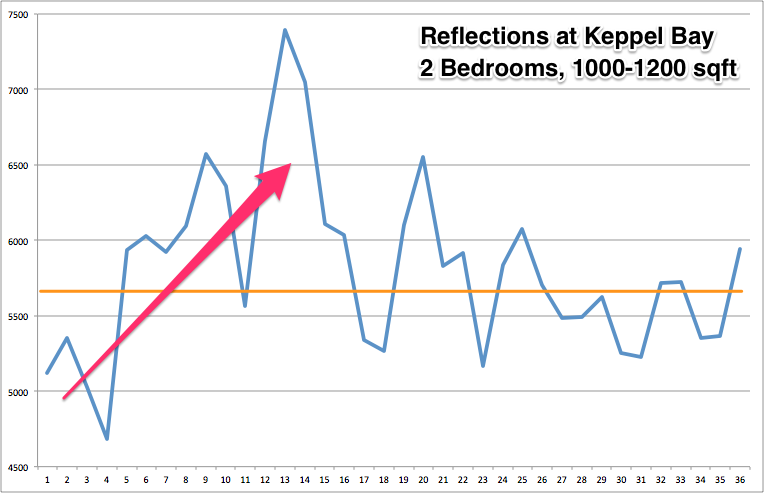
To get some hard data, we consulted the URA who publish lease data every month. Fortunately, the URA started publishing this data from the start of 2012, although these days they only keep the last 36 months on the site at any time. However we have the data since 2012 so could take a look at the early Reflections leases. We decided to first focus on the 2 bedroom apartments between 1000-1200 square feet, which are the most common there. Here’s the graph with our own annotations: 


This graph definitely shows a trend, as we’ve annotated. Although rent within the first 3 years averaged $5,700/month, the earliest leases were clearly below this, before shooting up almost every month before hitting a peak around a year after the first leases were signed (I.e. The peak was early 2013). 

So did the earliest renters get a bargain? Did rent shoot up after that? Did rent return to “normal” levels after that? Yes, yes and yes - or so it seems. 
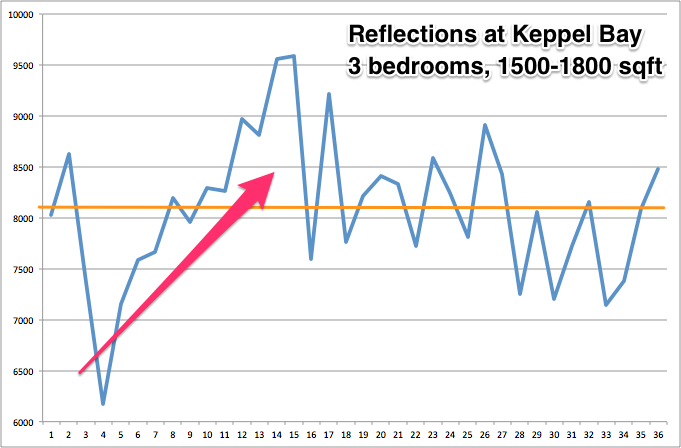
To see if this was just by chance, we looked at 3 bedroom apartments between 1500 and 1800 square feet. We saw similar results: 


To check one other anecdote, we wanted to see if we could spot any trends in lease renewals 2 years after the first leases were signed (2 years is the typical lease length, especially in 2012). What we saw was really interesting: 


From the above you can see that the average monthly rent in 2014 was higher than 2012 for the first 4 months only, and after that leases signed in 2014 decreased compared to the equivalent month 2 years earlier. This would indicate that the earliest tenants probably did get a bargain in 2012 because the equivalent leases in 2014 were higher, meanwhile those who rented from 5+ months since launch perhaps overpaid, considering leases were negotiated down two years later. This decrease could also indicate a decreasing rental market in general in late 2014 though.  

Based on this Reflections data, we can draw some probable conclusions: 

1. Early tenants definitely got a great deal on rent compared to average 

2. As the number of available apartments dried up, tenants seemed willing to pay a premium 

3. After the first lease cycle, the bargain leases were negotiated up while later leases were negotiated down 

4. Although early leases went up and later ones down, the earlier ones were still cheaper than later 

We’ll draw some conclusions for landlords at the end too. 

Caspian 

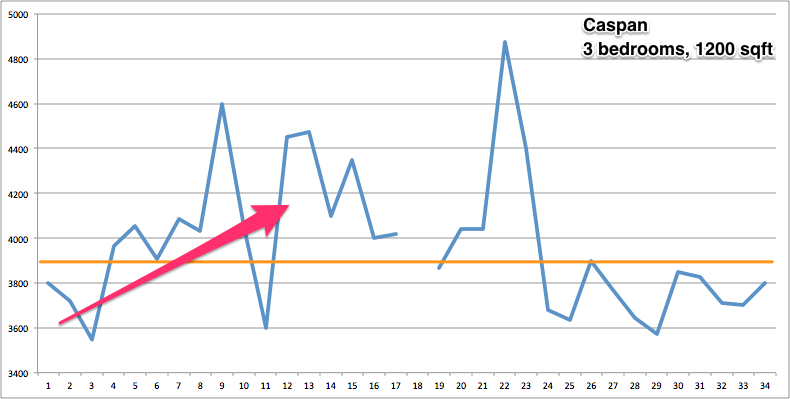
Caspian is a cheaper condo than Reflections at Keppel Bay, which started registering leases in the last quarter of 2012. Taking a look at its 3 bedroom 1200-1300 square feet apartments (the most common size), we see a similar trend of prices in the first few months being below average: 


As Caspian started leases more than half a year after Reflections, its lease renewals would have been hit much harder by the down rental market in late 2014 than Reflections was, so let’s take a look at the data for September 2012-2013 vs the same period in 2014-2015 so far: 


It’s a little harder to draw any conclusions from this, although we can see that leases 2 years later in the late 2014 were higher than in late 2012 while the remainder averaged lower than two years earlier. But as mentioned above, by 2015 we were truly entering a downturn in rental prices so it’s hard to conclude anything for sure. 

Meadows @ Pierce 

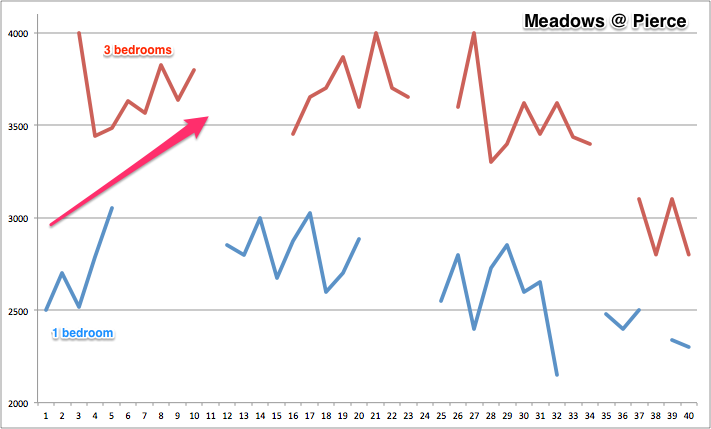
For our final analysis, we looked for another from early 2012, so it would be less impacted by the rental downturn in 2014-2015. For Meadows, we looked at both their 1 bedroom apartments - which leased first - as well as their 1100-1300 square feet apartments that sometimes get classified in URA data as 2 bedrooms and sometimes 3 (we just use label of 3 on our graph): 


What’s interesting here is to see how the supply of apartments actually stopped after a few months. Still, the same pattern emerged where apartments are priced under average in the first few months before shooting up as availability decreases. 

Conclusions for Tenants 

We’ve only looked in to three condos here, but it seems that the data backs up anecdotes that you really can get a bargain on rent if you move into a new condo in the earliest few months. But also beware - it seems that these new condos may become overpriced for rent once supply decreases. More good news for tenants in both cases though - it would seem that when leases are renewed, the earliest ones did not completely shoot up, meanwhile the most expensive ones did seem to come back down.  

Conclusion for Landlords 

If you’ve already bought a new condo off the plan, or considering it, then this data is very important for you too. It seems clear that a new landlord has a choice: either race against the clock to fill your apartment early for a cheaper price, or hold out longer with no tenant until you can get a better price. In the case of Reflections at Keppel Bay, we saw leases for the same size apartments increase on average by hundreds of dollars a month for the first few months, which would really add up for a 24 month lease - let alone if the tenant stays longer and you don’t have to negotiate so much again.  

Also, the price at which you rent your condo out can also play an important psychological part if you’re actually planning to sell within the first two years - obviously it’s easier to get a good sale price for your condo if you can show that you’re also getting a good monthly rental. Another factor is that the extra months at the start could give you time to make capital improvements to the apartment that allow both a better rental as well as better sale price in future. 
What do you think - have we missed anything?

Rhys Arkins is the founder of Key Location, a website dedicating to giving people better data about renting Singapore condos

Sunday, 2 August 2015

Entrepreneurship : How To Setup A New Company In Singapore?

The following is a guest article from: The New Savvy

Entrepreneurship seems to be the buzz word in Singapore nowadays, with many people rushing to create new companies. If you’re getting ready to make that first step and create your own start up, you might be confused by the many different types of business structures available to you.


Here’s all you need to know about being your own boss and setting up a business:

Things You Need To Consider


  1. Are you alone in this venture, or do you have partners?
  2. Are you willing to risk unlimited liability, or do you want to limit liability?
  3. Are you willing to be taxed at a personal level? Or would you like the venture to carry the tax burden?


Things You Need

1. Singapore Citizens/PR

Singpass
If you’re a Singapore citizen who has forgotten your Singpass password, it can be reset most Community Centres and locations here or reset it online.

An online payment method

Details of all the partners in the new venture (I/C Number., Address, Name, Contact No.)

2. Foreigner

An Entrepass which you must apply for
An online payment method


Different Business Structures

1. Sole Proprietorship

One of the most common form of business in Singapore, a Sole Proprietorship is a business run by a single person. The business and the owner are considered the same legal entity. The owner is personally liable for all debts and losses of the business. Profits are taxed at the owner’s personal income tax rates. Sole proprietorships need to be renewed every year.

Set-up Fee: $65

2. Partnership

A business that has between 2 – 20 partners. The business and its owners are considered the same legal entity and the partners are each personally liable for the partnerships debts and losses. Profits are taxed at each partner’s person income tax rates. Partnerships need to be renewed every year.

Set-up Fee: $65

3. Company

A business that is a separate legal entity from its shareholder and directors. The business is considered a separate legal entity from its shareholders. Shareholders are not personally liable for debts and losses of the companies, though they may lose as much as they had invested. The rules on companies are set out in the Companies Act. Profits from a company are taxed at the corporate tax level. It should be noted as well that the annual filing procedures for a company are probably the most sophisticated among all the business structures mentioned.

Set-up Fee: $315

4. Limited Liability Partnership (LLP)

A structure that was not available in Singapore till just a few years back, an LLP provides the partners some rights of a partnership and some rights of a company. LLP’s do not have unlimited liability, like a company their partners are not responsible for any debts or losses that the business incurs on a personal level, unless the partner is personally responsible.

LLP profits are also taxed on a personal level instead of the corporate level, thus combing the best elements of a partnership and a company.

Set-up Fee: $165

5. Limited Partnership

Limited Partnerships is the newest business structure available in Singapore. With a minimum of two partners, a minimum of one as a general partner and a minimum of 1 as a limited partner. General partners are liable for all debts and obligations while limited partners have their obligation limited to the amount they contribute to the business. In most other aspects though, this is similar to a partnership.

Set-up Fee: $65

How To Set Up Your Company

Go to ACRA website and click under the appropriate tabs and follow the instructions.


Read more at The New Savvy  if you want to know more. The New Savvy is a financial platform that aims to empower women through meaningful content that are relevant and practical. The New Savvy provides resources to demystify finance and spur financial consciousness. We want to make money interesting to women and transform women’s relationship with money.

Republished with permission. All rights reserved. 

Monday, 15 June 2015

Become a Savvier Online Shopper: 5 Tricks and Tips to Note!

It’s time to face up to the facts - online shopping is in. With retail therapy conveniently moving online, physical shopping might very well be on its way to becoming obsolete. Of course, that shouldn’t be a cause for concern - any online shopper will know the satisfaction of placing an order online, and having it doubled when receiving the precious parcel a few days later. And there’s no need to have it all at the expense of your wallet - here are five insider tips to help you turn your online shopping trials into triumphs.

1. Filters

If you haven’t been using filters when you browse online, you’ve been doing online shopping the wrong way. Sort your online goodies from Price Low to High to root out the best deals on the site, and keep everything organized for your browsing ease.


For those frustrated at having to sift through pages of irrelevant but cheap items, that’s exactly where the price range toggles come in. Simply adjust your minimum price to something reasonable of the category and you’ll be good to go. Then again, for those who like challenges, feel free to keep the minimum price at $0 – after all, you never know when an extra value deal sneaks its way into the game.


Price filters aside, you can also play with the various filter options provided to you by the website - in clothing sections alone, filters like size, length of skirts, colours, brands and more can really help to narrow down your options so you can access exactly what you want, instantly and efficiently.

2. Sign up for the newsletter

Believe it or not, the online newsletter exists for a purpose larger than flooding your inbox with useless spam. Signing up for the store newsletter gives you advance notice on sales and updates that could do wonders for your savings account.


In exchange for your elusive email, stores tend to reward customer's loyalty with sneak-peek ‘first looks’ at upcoming sales, and sometimes even the handy coupon code. When that happens, you definitely don’t want to miss it out. For many online stores, if you go the extra mile to sign up for an account, you’ll often be gifted with a special discount code on your birthday.

It’s a worthwhile trade for your inbox space, but if you’re still a little hesitant, here’s a tip –create a separate account purely for online shopping accounts and updates. That way, if you’re ever in the mood to part with your money, you’ll find a whole host of avenues waiting neatly for you in one place.

3. Cash in (or out) on holidays


Public holidays aren’t just good for a free day off from work or school now – online stores have cashed in on the holiday hype (and the fact that people are happier on a break) to entice customers with special promo codes and sales. Take a look around: Zalora, ASOS, Lazada, Groupon are just some of the big names that have taken to offering holiday-specific discounts when the occasion arises. Take your pick from Mother’s Day, Father’s Day, Labour Day, and the many other extraneous holidays that bring with them an onslaught of much appreciated discount codes. So if you’ve got your eyes on something, it might help to keep the other eye out for any upcoming public holidays before you place that order. 

4. Resist – curb the urge!


Strangely enough, playing hard to get with your favourite online store works, especially when you’re usually a loyal purchasing customer of the website. From a tried-and-tested perspective, if you refrain from ordering from ASOS for a substantial period of time – whether intentionally or not – this British retailer will very graciously send you a “We miss you, take 20% off!” promo code, exclusive only to you.
Singapore’s Zalora too, has been known to show the occasional act of generosity if you leave something simmering in your cart for a few days. For anyone intending to make a hasty purchase at full price, it might be worthwhile to consider playing the waiting game, because indeed, good things come to those who wait. 


5. Use CashBack Websites!
It’s a little novel to us here in Singapore, but getting money back when you shop has been a popular trend for quite a while now. Most famously done in the US, shoppers can get cashback from purchasing their favourite brands through the particular cashback website. It’s a nifty notion that has thankfully made its way onto our shores  – the cashback sites get their commission, and you get a portion of the money you spent credited back to you.
One such website that offers cashback to the South East Asian consumers is ShopBack Singapore – in addition to cashback on over 500 shops, you’ll get access to current active promo codes and discount codes for those stores including ASOS, Zalora, Groupon, Expedia, Agoda.com, and hundreds more. Once you’ve accumulated at least $10 of cashback in your ShopBack account, you can conveniently cash it out into your bank and PayPal accounts helping you save more online. 


At the end of the day, getting the most out of your online shopping experience comes down to shopping smart. Understanding and knowing how best to work the ways of the websites will help any avid shopper get a good deal - possibly even more than in shopping real-world retail. And honestly, who needs instant gratification when you can have the delayed pleasure of receiving a parcel addressed to yourself, from yourself?  

Amanda writes for cash back website ShopBack Singapore and has 48 pairs of shoes. Other than that, she's pretty good at handling her finances.

This post is brought to you by Shopback. Sign up and start enjoying cashback for your online purchases today!